Introduction
Embarking on a new job can be daunting and comes with much anxiety and apprehension. You find yourself in a strange new environment, surrounded by unfamiliar faces and tools. The legendary myths about people who fixed a 50-year-old bug on their very first day inspire you, so you aspire for a similar flawless flying start – just like the heroes in these stories:
- You want to hit the ground running.
- You want to make a big-bang impression quickly.
- You want to get it all right.
In reality, you are like a toddler taking his first steps – your little knowledge of the required tools, systems, and culture makes this lofty target impossible. This tension between the desire for quick wins and the reality of starting afresh often leads to undesired outcomes, such as impostor syndrome, loss of confidence, and second-guessing.
This article’s intended audience is experienced professionals starting in new domains. It highlights common pitfalls, facts and a strategy to smoothen onboarding. Some of these tips are hard-learned lessons acquired from ramping up repeatedly across multiple teams, reviews of personal mistakes, and wisdom from experts.
Common Mistakes when starting a new role
- Violating Chesterton’s fence: Too many leaders rush changes without understanding the background. A few weeks of patience and thoughtful deliberation can save you several months of exorbitant repair work repairing fences.
- Doing too much at once: If everything is important, then nothing is important. Such leaders get spread so thinly chasing every opportunity that they do not catch any.
- Deprioritizing relationship building: Instigating disruptive changes before earning sufficient trust and credibility. Maya Angelou’s quote comes to mind: “I’ve learned that people will forget what you said, people will forget what you did, but people will never forget how you made them feel.”
- Undercommunicating: Some leaders have unwittingly seeded chaos by failing to communicate their intentions and surprising everyone.
Some facts about starting afresh
It’s natural to experience a mix of emotions when starting. You’ll find yourself lacking in familiarity and expertise; your skill and output will drop inevitably. Another challenge is handling your limited influence and connections. Embrace this discomfort; it is a temporary phase as you navigate the learning curve; know that you will strengthen and develop your technical skills, relationships, and influence over time.
- Productivity dip: Everyone starting a new role or position encounters some temporary incompetence. For example, a staff engineer will most likely perform as a senior engineer during ramp-up. This dip is normal because you are learning the ropes. Instead of dwelling on your discomfort, you should focus on shortening your ramp-up period.
- Information overload: The overwhelming deluge of information can make you think you are failing at the job. This can lead to a severe loss of confidence cycle with predictable disastrous outcomes. Break out of the self-doubting loop – instead, set yourself actionable milestones. It is OK if you do not know; after all, you are new on the job and ramping up takes time.
- Fear of others: Worrying about being judged? Here is the sad truth – someone somewhere will judge you; it’s inevitable because it is a typical human trait, and there is little you can do about that. Your peers will compare you to others; your team will cautiously watch your actions. You might say it is unfair for folks to judge you, but you probably judged your last manager. Thus, do not let such concerns overwhelm you – you can’t control them anyway, so why bother?
Don’t miss the next post!
Subscribe to get regular posts on leadership methodologies for high-impact outcomes.
A proven strategy
There is a way to systematically ease into a new job and make a significant impact in a sustainable fashion. This strategy will also get you to deploy your strengths and execute at your full potential in no time.
This approach is rooted in Boz’s excellent career cold start algorithm post; I have evolved my 3-step version by tweaking and introducing new aspects. My current approach helps me build an accurate mental model of any team within three to four weeks.
Stage 1: The listening tour
The listening tour is an incredibly high-leverage investment – it is a series of interviews, a methodical approach to quickly gather information about the organization’s work styles, key stakeholders, and expectations.
Typically, you’ll have a pre-selected list of folks to meet and ask questions. Initially, those meetings were freeform and unstructured: the folks would ask, “What do you want to know?” I always responded: Tell me whatever you think I should know. Over time, I moved from unstructured free-form conversations to a highly structured interview process that optimizes the 30-minute discussion.
A great icebreaker after introductions is to start by declaring, “I’m here to interview you! And like an interviewer, you’ll notice me taking copious notes.”
You should ask the same questions on the listening tour because this makes it easy to extract insights when analyzing your notes in phase 2. Here are some sample questions and why you should ask them.
Questions
| Question | Why |
|---|---|
| What are the challenges the team is facing? | An excellent way to start gathering information on the current pain points; this helps to identify low-hanging fruits that everyone wants fixed but no one wants to do. Keep it free-form since you do not know enough about the space to ask directed questions – you want to hear everything. |
| What mistakes should I avoid? | You learn from organizational lore about failed experiments – no point in repeating mistakes. |
| What would I do that would piss you off? | People often say, “No, you can’t piss me off; I’m even-keeled”. Do not interrupt; give them space to think deeply about this question. The answers nearly always reveal deep insights about the organizational culture or potential tripwires. |
| What are the expectations for my role in this organization? | This helps you understand the implicit expectations for your job and the yardstick you will be measured by; different people will have different answers, but patterns will emerge once you start compiling notes. |
| What’s your preferred communication style? | Helps with tailoring your communication for effectiveness. |
| How can I make you successful? | Listening and following through demonstrates your commitment to collaboration and teamwork. |
| Who else should I meet? | Start building the influence map for the organization, especially the critical stakeholders who influence many decisions but might not be so apparent from looking at the org chart. |
Stage 2: Analysis
The stage involves analyzing your notes to identify the next steps. You should have your notes listing all the responses from the listening tour. The analysis stage is a crucial step in the onboarding process, and here are the desired outcomes:
- Key influencers: Track the names that keep coming up across your interviews; those folks possess much influence, regardless of their role, tenure, or title. These people are the key influencers in the organization, even if they do not occupy prominent spots in the organizational chart.
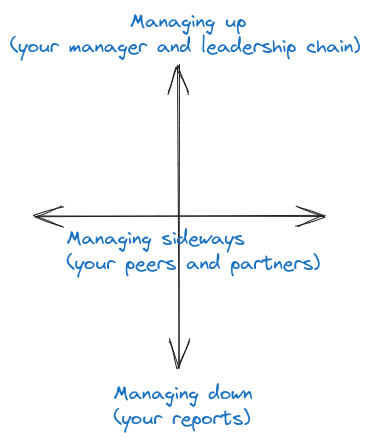
- Critical partners: Identify the people you’ll work closely with so you can build the necessary relationships before you need them. You want to be able to manage up (your manager, his peers, and their managers, too), down (your crew or your team), and sideways (your peers). Proactively nurturing these relationships reduces interaction overhead and friction.
- Quick win candidates: The “what’s a challenge” question should reveal low-hanging fruit you can exploit to generate goodwill and win some credibility. Try compiling a list of these quick wins.
- Dissonance: Is there a difference between what the team members say and what external partners say? That is a ripe area to dig into and might indicate some friction.
Stage 3: Choosing your path
At this point, you know the lay of the land and have a list of quick wins. Halt! Don’t dive in yet; here are a few more tips:
- Focus: You are faced with a dizzying array of low-hanging fruit. Do not try to boil the ocean; pause and evaluate. A good way is to pick up a challenge you have some prior experience with – that way, the only variable is the new domain. You know you are focusing when it hurts to let go, when you wish with every ounce in your body to pursue an opportunity, but consciously let it go to prioritize something else.
- Over-communicate: Once you’ve identified your top priority, you must overcommunicate your choice and why it is important. This approach minimizes surprises and ensures smooth execution; furthermore, you can immediately get course-corrected if that is the wrong problem to solve. You need to carry folks along to achieve the goals, you can’t do it alone. And it’s way easier to achieve goals if folks are bought in than to fight an uphill battle fraught with frustration and setbacks.
- Be sensitive: Don’t ask “why did you do this?” Rather ask, “What were you aiming to solve?” The direct ‘why’ question might trigger defensiveness – folks might think you are insinuating they got things wrong.
- Fish-in-water metaphor: The things that seem wrong to you are probably wrong (see Dan Luu’s excellent normalization of deviance post); take note of them – fresh eyes and perspectives are always great.
- Share an About Me doc: Writing this requires thinking about yourself, your style, strengths, and shortcomings. Even if no one reads it, the self-discovery pays back in manifolds
- Listen with curiosity: You must listen deeply to stand a chance of hearing what people are not saying.
Conclusion
I hope this 3-step process helps you hit the ground running; feel free to adopt what works and drop what doesn’t. I’d appreciate some input on what you found useful, though.
Don’t miss the next post!
Subscribe to get regular posts on leadership methodologies for high-impact outcomes.
Discover more from CodeKraft
Subscribe to get the latest posts sent to your email.
