As a manager, it’s easy to get caught up in the day-to-day tasks and lose sight of the bigger picture. However, as a leader, taking breaks and assessing the situation periodically is essential. Like a long-distance swimmer, you must take a breather, course-correct, and align yourself with your goals. Then, you can put your head down and continue swimming in the chosen direction.
Most teams typically have a boatload of important customer requests, and navigating this maze of competing demands is challenging. It can be difficult to prioritize and allocate resources effectively, especially when facing demands and pressures from all directions. Most leaders struggle to balance work and necessary resources to position the team for sustained success.
Common challenges include:
- Allocating resources amongst multiple competing priorities.
- Effectively communicating choices to stakeholders.
- Positioning the organization to win in the short and long term.
- Avoiding reactionary chaos due to myopic flip-flopping.
Let’s explore the BCE framework for overcoming these common obstacles and positioning your team for short- and long-term success.
This framework helps you reason about work, resource allocation, and investments. It provides a high-level vocabulary that empowers you to ask the right questions and make necessary adjustments. Using this framework, you can align organizations with a common language, simplifying communication with stakeholders and enabling you to be effective.
The BCE Framework: Business, Customers, Engineering
The framework categories work into three major themes:
- Business needs: All successful companies have two essential work categories: strategic investments to win the market and operational investments to fulfill contractual obligations.
- Strategic: Exploring new opportunities prevents an imperceptible slide into irrelevancy. Being effective requires taking bold bets and conducting regular experiments, with the willingness to ruthlessly prune failed bets.
- Operational: Fundamentals such as compliance, security, and reliability are non-negotiable essentials for smooth business operations. As your business grows, the importance of these fundamentals also increases, as they are necessary for building customer confidence in your product. Keeping operational costs minimal is crucial to be effective.
- Customers: This work category is the most visible to everyone and thus is usually given too much focus. It involves delivering features that delight customers. However, what the customers want may not always align with the business objectives. For instance, most innovations start as something most customers do not know they want.
- Engineering Efficiency: This category focuses on achieving sub-linear scaling costs for engineering toil (see multipliers) and boosting engineering productivity. This differs from the operational business categories since it’s possible to meet business fundamental needs at an exorbitant cost and vice versa.
Note: When a project spans two or more categories, the category with a broader impact wins.
Applying the BCE framework
The right mix of investments for your organization depends on your product’s maturity. Think of it as an investment portfolio where you are attempting to allocate limited resources to maximize returns.
For v1 products, you must invest heavily in the business category to achieve product-market fit. For products going through hypergrowth, your primary focus should be retaining customers and maintaining the growth rate. Finally, if you have a mature product, you’ll need to allocate significant resources to engineering efficiency to reap the benefits of scale.
Here are examples for each category as a thought exercise:
Don’t miss the next post!
Subscribe to get regular posts on leadership methodologies for high-impact outcomes.
v1 Products
At this stage, you are attempting to find product-market fit. You already have a new idea but are unsure if customers are interested. Since you have zero or few customers, investing heavily in finetuning your ideas without customer input is counterproductive – you risk doing the wrong thing. Therefore, it is crucial to have a strategic vision for the concept, build it quickly, give it to users, and accelerate the feedback loop. This will allow you to finetune the product until you achieve product-market fit.
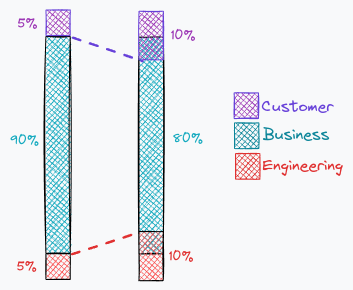
You might think you can get away with 0 engineering at this stage – I’ll caution against it. Tech debt incurred at this stage can incur exponential repair costs in the long term. The proper focus will accelerate your iterations, boost productivity, and prevent costly mistakes.
Hypergrowth
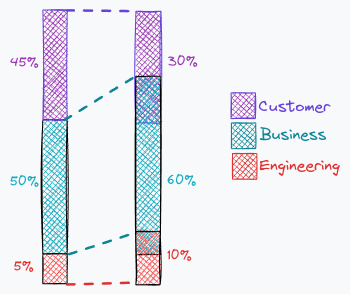
For products at this stage, you understand your customers’ needs well but still need to implement your strategic roadmap fully. To retain your current customers, you must address their needs; to capture more customers, you must continue with your strategic priorities. Thus, you must expand your investment in the customer category at the expense of business-focused allocations while continuing to fund engineering needs.
Mature
Congratulations! You have succeeded – millions of users, a recognized brand, and lots of money. The product has momentum, and you have so many customer requests that responding to the pent-up feature requests will take years. Significant operational investments are now necessary to avoid jeopardizing customer safety.
Getting lulled into a false sense of complacency by the market lead or distracted by the day-to-day operational needs will ultimately cost you your place (aka innovator’s dilemma). Thus, you must consider big bets – high-risk/high-reward investments that position you for sustained wins.
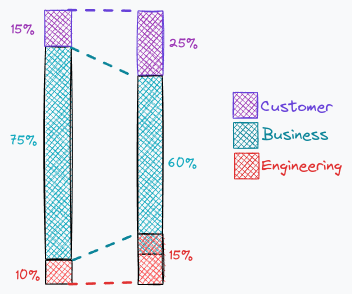
Tech debt incurred at earlier stages will determine how many painful spots need to be nurtured. If things are allowed to fester, your engineers will become unhappy and probably quit. You risk turning your organization into a revolving door and hurting your ability to execute1.
Note: This is why no one wants to touch tech debt and why big companies are less agile at execution.
Tips for using the BCE framework
Periodically rebalance your portfolio and Diversify your investments
It is crucial to avoid having zero funding in any category for an extended period as it poses significant risks. Even though it may be tolerable in the short term, persistent lack of funding over several quarters can have the following outcomes:
- Business: Start-ups out-innovate you and eat your lunch
- Customer: Customers churn because you are not responsive
- Engineer: Engineers quit because engineering toil is too high
Chaotic churn
A signal of organizational chaos and churn is when engineers are frequently moved across categories every few weeks. This implies flip-flopping – a situation where major initiatives across different categories start and stop every now and then. Stabilizing with clear work allocations and pathways for longer periods is better. This will build stability and lead to better outcomes.
Tips
- A successful strategy is to create a separate bets organization or team.
- Revise your investments using the BCE framework, have you been flip-flopping?
Alignment
This framework simplifies communication by providing a common vocabulary for engineers, PMs, designers, support, and leadership. It clarifies the why and what, making it easier for everyone to understand the vision and make tradeoffs. It should make it easier to have the funding discussion for engineering and make a case to leadership since you are showing the risks of short-sighted decisions.
Conclusion
This framework should help you in three ways:
- Think of your current decisions and their long-term implications.
- Prioritize and allocate resources effectively, amidst competing demands
- Communicate your strategy to your customers, stakeholders, and organization
This should help you avoid painting yourself into a corner that is hard to extricate yourself from.
Don’t miss the next post!
Subscribe to get regular posts on leadership methodologies for high-impact outcomes.
- Amazon is notorious for its pager duty for a reason, while Google has a reputation for immense leverage due to its engineering systems.\ ↩︎
Discover more from CodeKraft
Subscribe to get the latest posts sent to your email.

Thanks for sharing this framework, it seems very timely with my current work situation. I’m curious if we can apply the BCE framework to a real life situation, whether historical or current or something at your work to see how it worked well or didn’t or something about the framework was misapplied and thus lead to one of the failure modes outlined.
LikeLike
Hello there!
I do have examples that I have shared in the past; for example, this post – https://abdulapopoola.com/2021/08/16/from-chaos-to-comfort-transforming-business-output-by-eliminating-pain/, covers some of the lessons of a product going through hypergrowth and having to pay down significant tech debt.
Please let me know if I can share more examples.
LikeLike
The BCE framework is a structured approach to prioritizing work and allocating resources effectively. It categorizes work into three areas:
Business (B): Focuses on tasks that drive business growth and innovation.
Customer (C): Centers on improving customer satisfaction and responsiveness.
Engineering (E): Deals with reducing technical debt and improving internal systems.
The framework helps in balancing these categories to avoid neglecting any critical area. It simplifies communication across teams, helps in making informed trade-offs, and ensures long-term strategic alignment
Our software development services are designed to empower businesses by transforming their ideas into powerful software applications. Our software development solutions offer bespoke, cutting-edge technologies tailored to meet your unique business needs.
LikeLike
Your blog post on making resource allocations and prioritizing investments is incredibly insightful! I really liked how you broke down such a complex process into practical and actionable steps. As someone in a software development agency, I can see how your approach can help streamline decision-making while keeping business and customer needs in focus. Great work—thanks for sharing! please visit my website Tech Stack digital . com and support us
LikeLike