Goldilocks went inside. First, she tasted the porridge of the great, huge bear, and that was far too hot for her. And then she tasted the porridge of the middle bear, and that was too cold for her. And then she went to the porridge of the little, small wee bear, and tasted that. And that was neither too hot nor too cold, but just right; and she liked it so well, that she ate it all up.
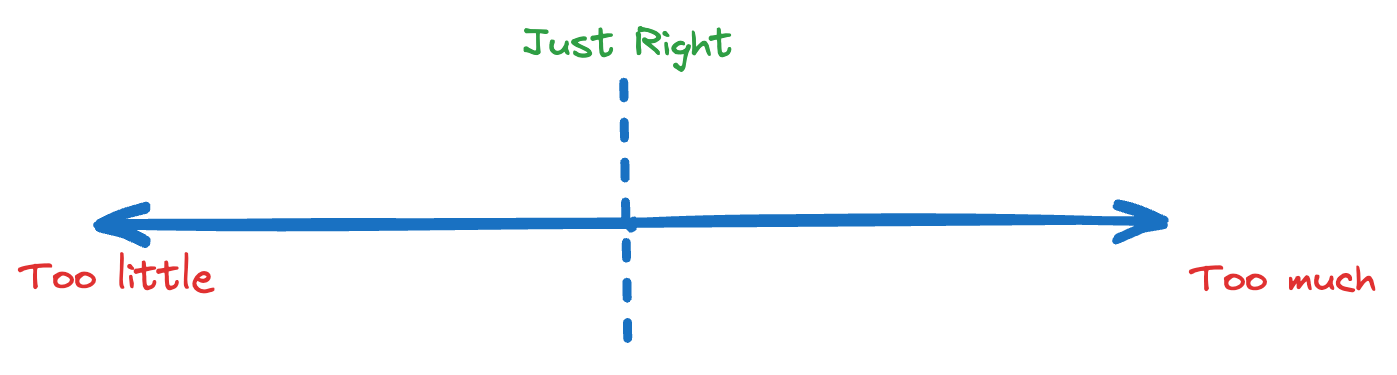
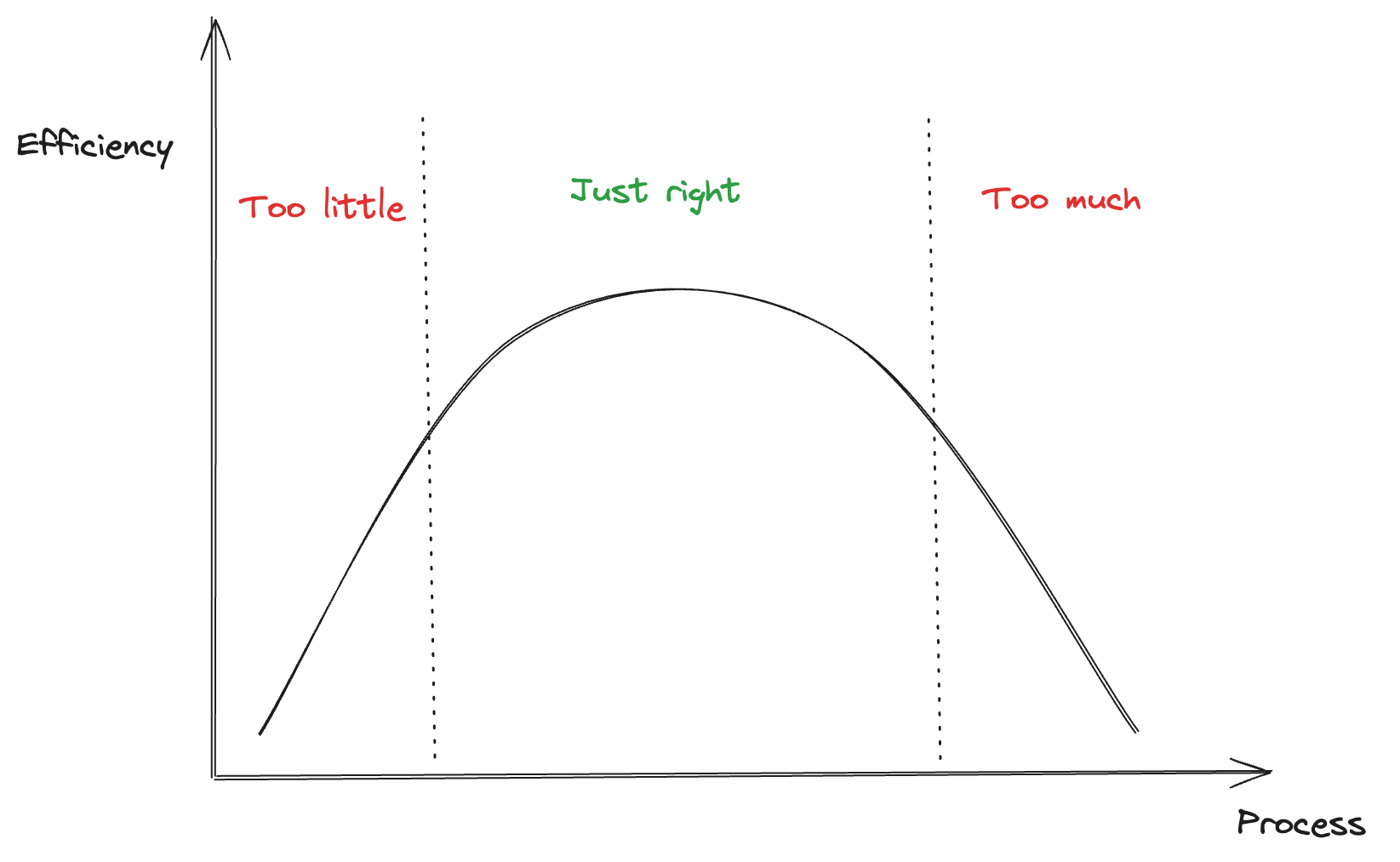
All the struggling organizations I have worked in shared one common characteristic. They had process deficiencies: some did too little, while some did too much. The best-performing orgs? They did just right.
This post explains this and offers suggestions and tips for leaders seeking to introduce change.
Too much, too little, and just right
The spectrum starts with “process aversion”, where anything goes. At the other end are “process juggernauts,” where everything must be approved by a committee of 19.
The two extremes of process-itis
If you’ve worked in the software industry for an extended period, you’ll recognize these two extremes: process-deficient orgs and process-straitjacketed orgs.
Process deficient orgs – Just too cold
No process
In these orgs, the “process” term is anathema. Say it, and the pitchforks come out – away with him who dares to utter the foul P word! Common symptoms:
- Active resistance to change: The group delights in rejecting all process incursions, whether perceived or actual. Common refrains:
- We’ve been successful without all these, so why change a winning formula?
- The leaders just don’t get it—they don’t understand how software is built or our problems.
- The manager wants to micromanage and control us.
- The work is done when it is done, gut-feeling-based estimates rather than systemic analysis.
- There are endless philosophical debates about why process is the cause of all problems in the world. These debates are buttressed by anecdotal horror stories of unpleasant prior experiences and battle scars.
- Ad-hoc definitions: The answer to most questions is invariably “It depends“. And you get seven different answers if you ask 5 people. There is a lack of understanding of what “done” means or team goals. Common examples:
- How expensive is this fix? It depends.
- How do we test before releasing? It depends
- How do we ship? When we feel like it.
- How long will it take? “small” means 2 hours to one person and two weeks to another.
- What is the source of truth? It depends as there are multiple boards, documents, and channels.
- Silos: There is no comprehensive crew-wide discussion or deep dive into ongoing work – everyone works in their way. Alas, this leads to inefficient communications and a considerable amount of hidden work due to unclear requirements, scope creep, and external dependencies, with attendant disruptions to execution.
Having no process is lightweight and can work for close-knit people, but it breaks down for groups larger than 4.
Food for thought
The “no process” approach is itself a process (your process is just “no process”). Have you tried estimating the actual costs of the ad-hoc no-process approach? How do you know it is effective if you haven’t measured it?
Don’t miss the next post!
Subscribe to get regular posts on leadership methodologies for high-impact outcomes.
Process overfed orgs – Just too hot
Organizations where the process is THE goal are on the other end of the spectrum. These orgs are slow-moving and process-heavy and only follow specific steps and guidelines. Several hours are wasted on ceremonies that do not solve any problem. Common symptoms:
- Pointless Ceremonies: There are endless sprint planning meetings, status updates, and reports—you have to fill out 27 forms before you are allowed to ship to production. There is a lot of effort but little results.
- Looping around a roundabout: Contentious decisions are rarely made despite everyone wanting a say. Instead of making a decision, members usually schedule more meetings to discuss everything but the elephant in the room.
- Learned helplessness: Folks know what to change but dread the uphill battle needed to bring about change.
- Process dogma: We are scrum/kanban/agile/insert-term – we’ve always and will always do things this way. The process has become the goal.
NASA needs this or health-critical software like EPIC or banking (I don’t wanna lose my money!!!). Very few mistakes slip through when done very well, but getting things done can feel like wading through a tarpit.
Food for thought
If your estimates are already perfect, why do you still need 4-hour planning ceremonies? Experiment with drastic cuts, invest the savings into new pursuits and see where you land.
Fixing this: making it just right!
You want to be in the middle with minimal waste. Depending on where your org is at, you either
- Introduce some structure for folks who are YOLO-ing it. OR
- Relax the constraints for folks who are straitjacketed by processes.
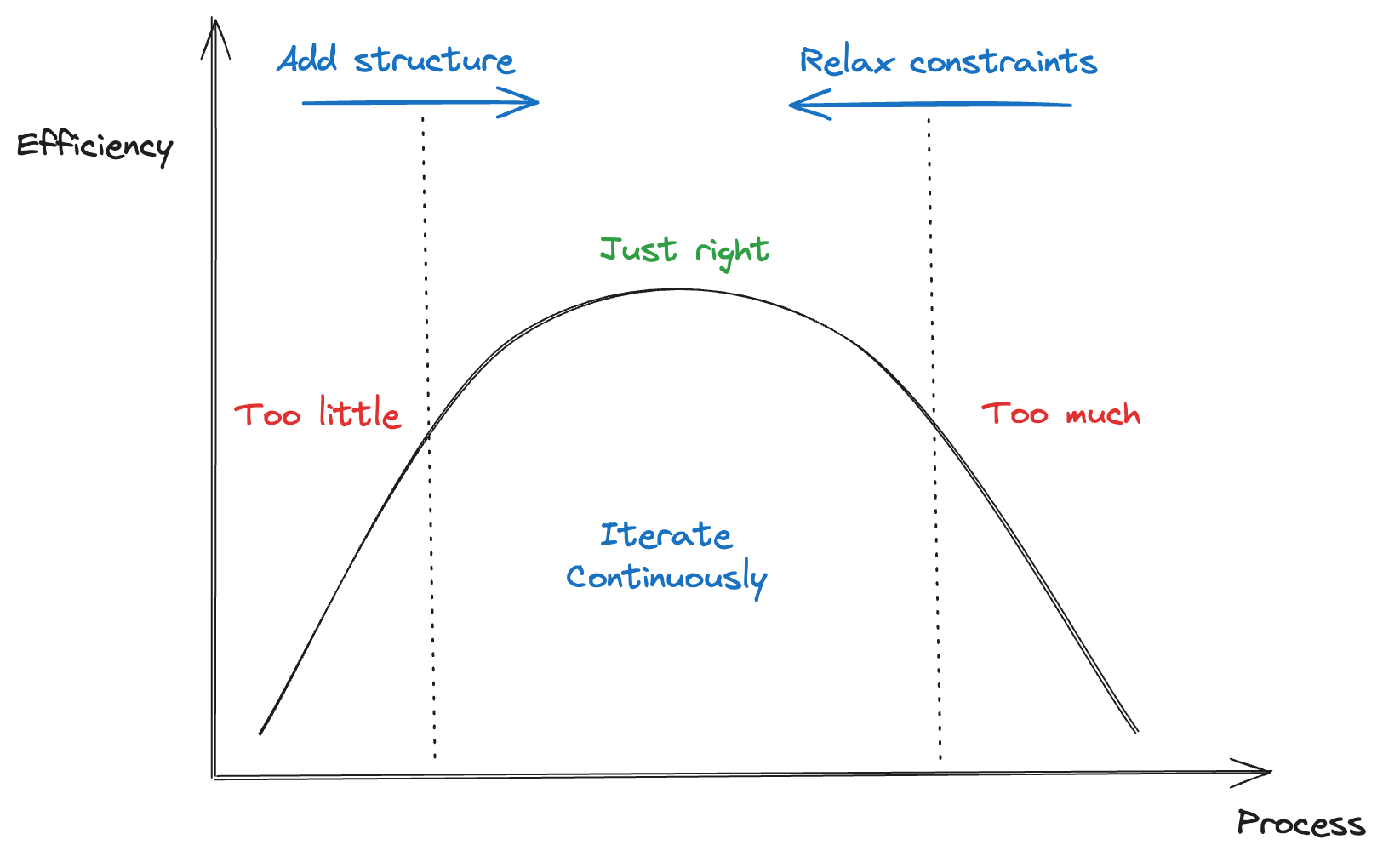
A 3-step approach to doing this
- Identification: know where you fall on the spectrum.
- Remediation: Commit to an experiment, no matter how small.
- Iteration: Set up a mechanism to assess outcomes and learn.
Experimental Ideas
Some quick experiments you can try.
- Focus on outcomes over approaches – the problem (the what) comes before the process (the how).
- Avoid invisible work – use one source of truth, preferably work item tracking software.
- Prune waste (i.e., meetings, reports, artifacts) – cancel meetings that have outlived their usefulness.
- Create clarity – being specific removes ambiguity, doubt, and confusion.
- Establish org-wide standards – for example, there can be no ambiguity on what “done” means.
- Iterate to improve – how can you improve without measuring and learning?
Conclusion
Analyze your organizational status using the efficiency-cost curve and experiment to make adjustments. Find the cultural reasons and systemic gaps that got you here.
Fixing processes is not a silver bullet—even if you have the right process, it doesn’t mean you will always ship the right thing; that is a different problem, and multiple facets go into it (culture, learning, etc.). However, having the wrong process will make you inefficient and most likely increase the odds of failing at the right ideas.
You’ve got to find your Goldilocks zone—it differs per organization, but you need to find it. Keep iterating; keep learning.
Don’t miss the next post!
Subscribe to get regular posts on leadership methodologies for high-impact outcomes.
Discover more from CodeKraft
Subscribe to get the latest posts sent to your email.
