My skip manager was equally right and wrong
She went straight to the topic: “Why do you want to leave?“, trying to dissuade me from leaving my current team. After she realized I was bent on leaving, she said, “That product has serious quality issues, so you should be careful.” Looking back, she was right because my target team did have quality issues, and she was wrong because the quality issues didn’t matter at that product’s maturity phase.
She had unconsciously fallen into a common leadership trap: superimposing the best practices of a mature product on a nimble startup.
This post discusses product maturity phases – the challenges, high-leverage activities, and common failure modes at each phase. Tenured EMs and higher-level executives will find it helpful to examine their portfolios to understand strategies and prioritize problems.
The product maturity journey
Every successful product goes through a journey of innovation, hypergrowth, and eventual maturity. Today’s mature products were once struggling startups striving to gain a foothold in the market. When these startups succeed in establishing a beachhead and achieving product-market fit, they typically experience rapid and substantial growth. With consistent performance over the years, they eventually reach maturity at a large scale.
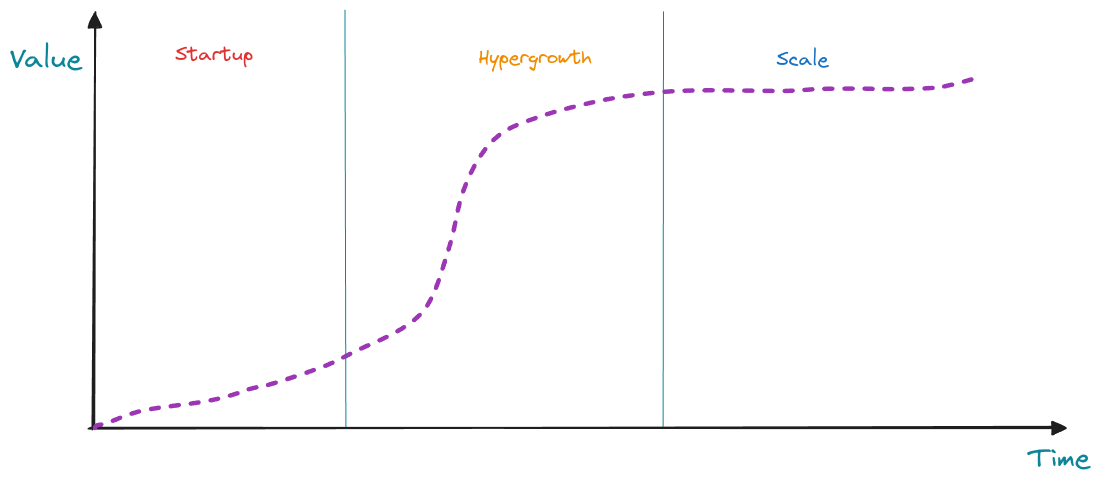
The pertinent questions at each stage vary:
| Maturity Phase | Strategy | Clarifying Question |
|---|---|---|
| Startup | Effectiveness | Are we building the right thing? |
| Hypergrowth | Retention | Are we keeping our customers? |
| Scale | Efficiency | Are we getting more with less? |
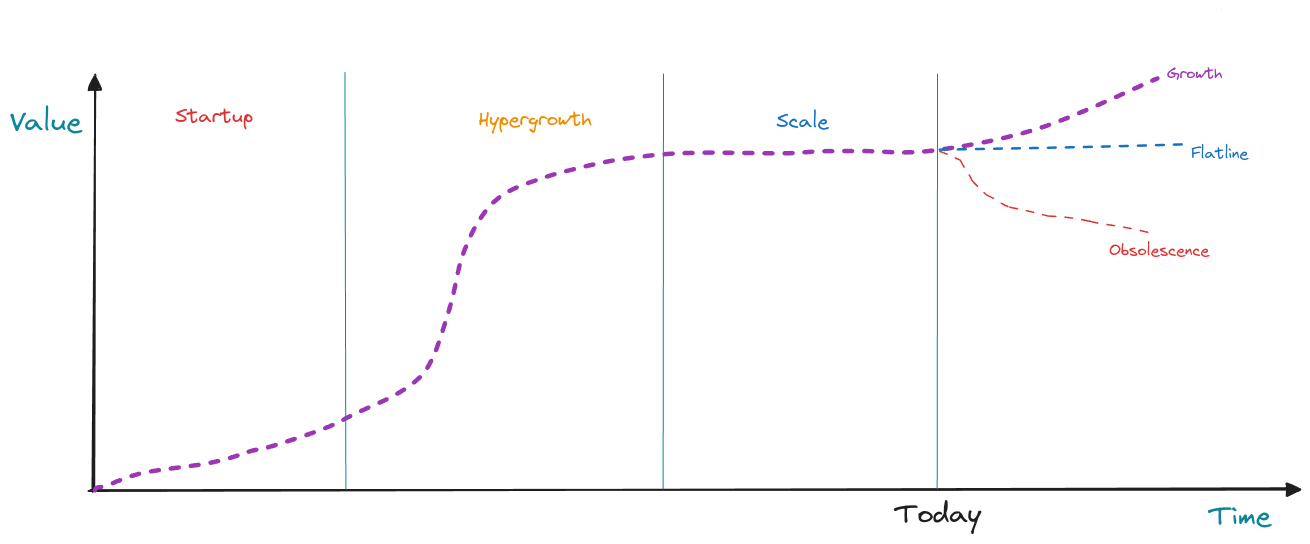
Note: A fourth phase applies to unsuccessful products—obsolescence and the transition to obsolescence can occur at any phase.
The Product Maturity Phases
1. Phase 1 – Startup
No one knows what they are doing; there are many ideas, and no one is sure what would work. There is a lot of excitement about the potential, and folks are eager to try out ideas. There are probably yet to be customers, even though some have given you promises, and it is hoped that it’ll work out.
During this stage, there is a focus on rapid innovation and a willingness to incur technical debt. When comparing delivery versus minimal technical debt, delivery typically takes priority at this phase because the objective is to achieve a Minimum Viable Product before running out of cash.
| Strategic Focus | Effectiveness – quick validation of ideas to achieve product-market-fit (PMF) |
| High-leverage activities | Experimentation |
| Customer base | 10s – 1000s of users |
2. Phase 2 – Rapid Growth
The product has established a beachhead and is on to something. You are now getting interested customers who like the product, so word of mouth is spreading. There is still a lot of risk, though. However, the ambiguity about direction and concerns about being successful are now reduced. You only have to execute and deliver in a direction, and you can be more confident that things will pan out.
As the product gains traction and grows rapidly, sub-optimal decisions taken in phase 1 start to bite. Common symptoms include reduced engineering velocity, increased customer complaints, and scaling pains. In most scenarios, the rapid orders-of-magnitude growth exposes the tipping points in the team, architecture, and processes.
| Strategic Focus | Retention – Keeping newly acquired customers |
| High-leverage activities | Observability, Quality, Release agility |
| Customer base | 1000s – 100,000s of users |
3. Phase 3 – Scale
The product is now a household name in its domain and probably number one or two at this stage. Think of Facebook, Excel, Google, or similar products. The most common challenge at this stage is that if problems now become when problems – if a problem has a 1 in a billion chance of occurring, it probably wouldn’t manifest in phases 1 and 2 but will indeed occur after some time elapses in phase 3. Any seemingly minor tech debt will now be magnified, and the associated inertia due to the large blast radius from multiple customers will complicate remediation options.
Similarly, the organization will have grown to handle the scale – potentially running into thousands of employees, and such growth comes along with the attendant organizational dynamics. Also, this will require hard decisions and tradeoffs because the product is so large and has so many users (no matter what you do, someone is going to be pissed off). Thus, you have to have sublinear engineering costs.
Finally, as an established product, it’s essential to consider the innovator’s dilemma—how to take safe bets and viola! You’re back at phase 1.
| Strategic Focus | Efficiency – Getting more for less |
| High-leverage activities | Standardization, Scalability, Automation |
| Customer base | 1,000,000 -> ♾️ of users |
Don’t miss the next post!
Subscribe to get regular posts on leadership methodologies for high-impact outcomes.
Common failure modes
The most common mistakes leaders make relate to strategy, team composition, and product maturity phase. These are the three most common failure modes:
- Right strategy, wrong team composition
- Right strategy, wrong product maturity phase
- Not strategizing
Let’s delve into each situation and tips for avoiding these.
1. Right Strategy, Wrong Team composition
Some turbulence is inevitable as teams transition across the phases. For example, people who enjoy working in phase 1 might find it challenging to adjust to phase 2 and vice versa. The leader is responsible for guiding the team through this transition and resetting expectations to prevent attrition and low morale.

I have firsthand experience of a team going through such a turbulent transition. A select group of engineers, who had spent their entire careers working on a Phase 3 product, were tasked with building a new product from scratch. The group defaulted to its standard approach and tried to efficiently build the first idea that came to mind – they didn’t experiment or validate if it was the right MVP or what customers wanted. Rather, they invested significant engineering effort into polishing that idea and making it ready to scale to millions of users. It was too late when they realized they had built the wrong thing, and the effort had to be scrapped with a predictable morale impact.
Tips: Hire, borrow, or train
- Hire: Consider bringing in individuals with experience at the stage you are transitioning to. For instance, hiring a seasoned staff engineer with years of experience in large-scale services can be very beneficial for establishing the technical direction of a product moving from phase 2 to phase 3. Experienced individuals also provide a calming presence as others grapple with change, uncertainty, or tradeoffs.
- Mix and match: If you can’t hire new employees, consider assembling a virtual team with members with the necessary expertise. This will require negotiating with your peers and may only be a temporary solution. Having the right mix of talent can help prevent future issues and increase your chances of a successful start.
- Train: If you can’t hire or borrow talented experts, focus on training. This approach is time-consuming, risky, and challenging, but it’s the only option when facing talent and budgetary constraints.
2. Right Strategy, Wrong Maturity Phase
Some leaders rigidly employ a one-size-fits-all approach, disregarding the product’s maturity phase or the team’s composition. This behavior often stems from their prolonged involvement with the product, causing them to overlook the need to reevaluate their leadership strategy.
I worked with a leader who was fixated on achieving exceptional stability. The issue was that he used a strategy suited for phase 2 (quality is crucial for retention), even though the product had already advanced to phase 3. His approach forced a square peg into a round hole: continuing with a phase 2 strategy and insisting on maximum stability without considering the exorbitant resource implications.
Tips:
- Seek Advice: You can benefit from seeking guidance and mentorship from individuals with more experience, particularly those who have successfully tackled similar challenges or possess innovative ideas that can push you out of your comfort zone.
- Look before you leap: Before diving into a new area without support, take the time to think deeply about your decision and how you’ll measure success.
- Know yourself: Question your habitual ways of thinking and doing things; understand the reasons behind your actions.
3. Not strategizing
Some leaders sit back and maintain the status quo until it’s too late, and they are forced to react. For products in phase 3, this complacency is evident in slow reactions to changes and a lack of innovation. For products in phase 2 or earlier, it shows up as slow pivots. Leaders who stop innovating become vulnerable to being outpaced by the competition.
Tips: Innovation tokens
- Make bets: For phase 3 products, innovation tokens can balance value delivery and high-risk explorations. Innovation tokens allow you to introduce and nurture new ideas (restarting the cycle at phase 1) while consistently delivering customer value.
More advice for leaders
- What got you here won’t get you there: Friction during transitions between product maturity phases is expected and manageable. Understanding this will empower you to lead with confidence and minimal anxiety.
- Business drives Tech: Always remember that a business’s success influences technology strategy, not vice versa. Without customers, even the best technology won’t pay the bills.
- Make complex tradeoffs: Prioritizing and focusing means making tough choices. As your product grows, you’ll need to make unpopular decisions, but as long as you explain and stick to them, it will help your organization in the long run.
Conclusion
This article explains what is most important at each product maturity phase and helps you prioritize the right strategy; it hopes to save you some angst and frustration. It also gives you some tips on pitfalls to avoid, and hopefully, with this knowledge, you can make the most of your product and build high-performing organizations.
Did you like this post?
Subscribe to get regular posts on leadership methodologies for high-impact outcomes.
Discover more from CodeKraft
Subscribe to get the latest posts sent to your email.

As salaamu alaekum warahmotullaahi wabarakaatuh, Quite a while sir, I thought of you recently about not seeing any newsletter from you in a while. Baarokallaahu feekum!
LikeLike
Wa alaykum salaam wa rahmatullaah wa baarakatuuhu,
Jazaakumullaahu khayraa for reaching out. Aameen.
LikeLike
I thoroughly enjoyed reading your blog post on “Leadership Strategies for Product Maturity Phases.” Your insights into the distinct challenges and strategic focuses at each stage from startup to scale—are both enlightening and practical. As someone involved in a software development agency, I found your emphasis on tailoring leadership approaches to the product’s maturity phase particularly relevant. Your clear articulation of high-leverage activities and common pitfalls provides valuable guidance for engineering leaders navigating these transitions. Thank you for sharing your expertise; it’s a valuable resource for the tech community. Also visit my website Tech Stack Digital . com will be very helpful for me to grow
LikeLike
I thoroughly enjoyed reading your blog post on “Leadership Strategies for Product Maturity Phases.” Your insights into the distinct challenges and strategic focuses at each stage from startup to scale—are both enlightening and practical. Techstack Digital
LikeLike
Insightful post! Understanding the strategic focus at each product maturity phase is critical for effective leadership. At Dotpot iT, we believe in tailoring our approach to each phase, ensuring efficient scaling and innovation while managing technical debt. Great advice for leaders navigating product growth!
LikeLike